
Ark Composites
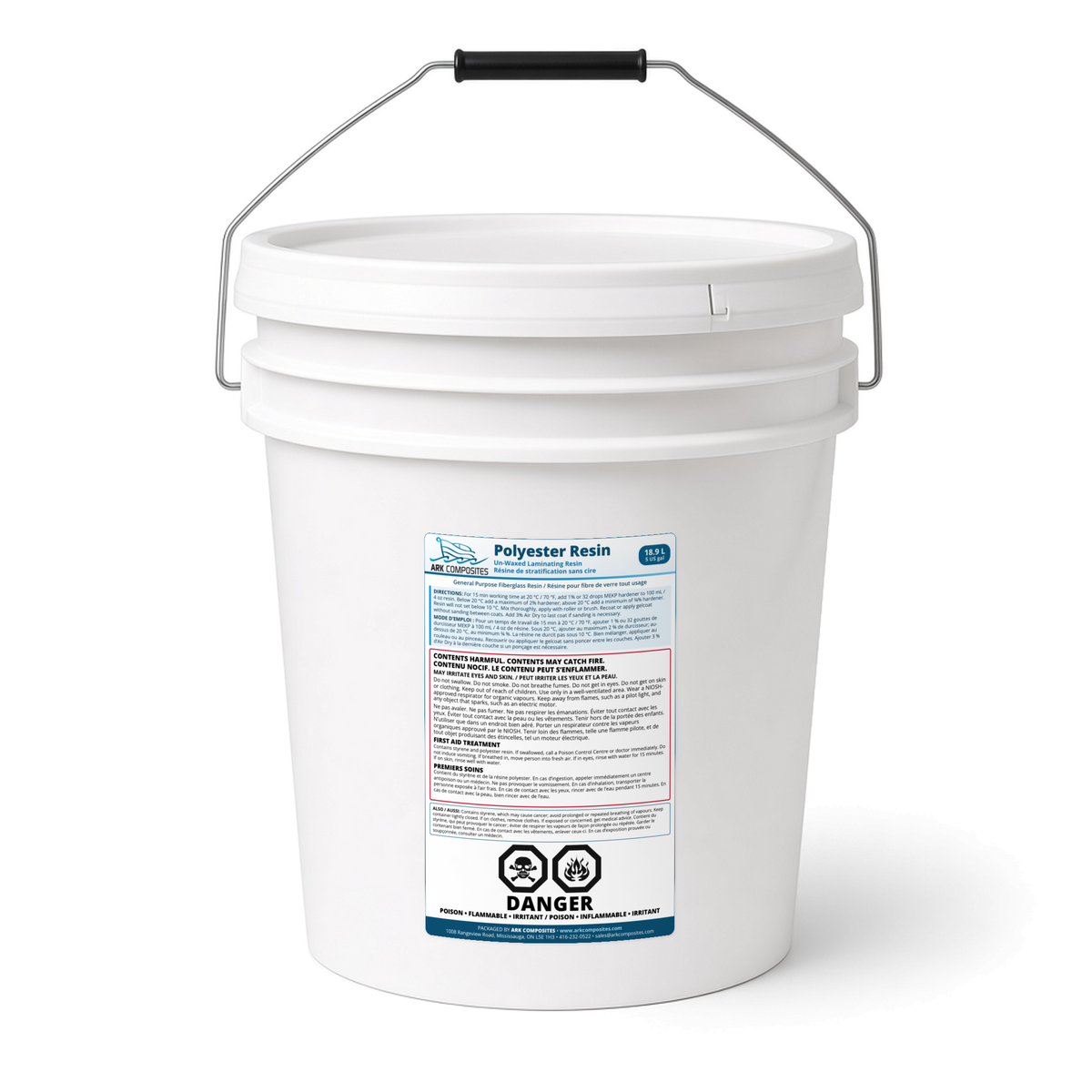
Polyester Resin Unwaxed
Polyester Resin Unwaxed
SKU:PR4
Ark Composites Unwaxed Polyester Resin is a general purpose polyester laminating resin for marine fiberglass lamination, layup and repair. It comes prepromoted and thixotropic, so you only add MEKP catalyst. It's medium reactive, with a 20-minute gel time at 1.5% MEKP. Because it is unwaxed (air-inhibited), the surface stays tacky after it cures. That gives excellent bonding between layers, which makes it the most popular fiberglass resin for marine work.
Key features
- Best secondary bonding: the tacky top layer bonds chemically to the next layer of resin and glass, which is ideal for larger, multi-layer projects.
- Ready to catalyze: prepromoted and thixotropic (TI 3.5+). Add MEKP at 1.0–2.0%.
- Fast, complete cure: medium reactivity cures fully, even in relatively thin laminates, at the recommended catalyst level and shop temperature.
- Tough laminates: with the proper glass content it makes a tough composite that helps reduce cracking.
- Sizes: 1 gallon and 5 gallon. A bulk drum is also available.
Applications
- Boat building, hull and deck lamination, and fiberglass repair
- Multi-layer layups with fiberglass mat or cloth
- Bathware and shower pans
- Water-resistant exterior wood decking and general industrial fabrication
Specifications
| Property | Typical value |
|---|---|
| Gel time | 20 min at 25 °C with 1.5% MEKP |
| Peak exotherm | 208 °F / 98 °C |
| Viscosity at 25 °C | 550 cps |
| Thixotropic index | 3.5+ |
| Styrene content | 45.1% |
| MEKP catalyst level | 1.0–2.0% of resin weight |
| Shop conditions | 18–32 °C (65–90 °F), 40–90% relative humidity |
| Cast mechanical properties | |
| Tensile strength | 12,000 psi / 84 MPa (ASTM D638) |
| Tensile modulus | 560,000 psi / 3.9 GPa (ASTM D638) |
| Tensile elongation | 3.6% (ASTM D638) |
| Flexural strength | 20,800 psi / 143 MPa (ASTM D790) |
| Flexural modulus | 580,000 psi / 4.0 GPa (ASTM D790) |
| Heat distortion temperature | 153 °F / 67 °C at 264 psi (ASTM D648) |
| Sizes | 1 gallon, 5 gallon |
Typical values for unreinforced, post-cured resin castings tested at 25 °C (77 °F) and 50% RH; not specifications.
How to use
Catalyzing
Use 1.0% to 2.0% full-strength MEKP by total resin weight. Work between 18 °C and 32 °C (65–90 °F) and 40–90% humidity; consistent shop conditions give consistent gel times. Catalyst, temperature, humidity, pigments and fillers all affect gelling, so check a small test batch under your actual conditions first. A catalyst dispenser makes measuring easier.
Layering and secondary bonds
Lay up the next layer while the surface is still tacky. If a laminate has sat for a long time, or been exposed to direct sun, heat or dust, abrade it before adding more layers. Sand or grind first when bonding to a laminate made with a waxed resin.
Laminating over gelcoat
Pre-wet the gelcoat surface with a thin coat of catalyzed resin before laminating.
Waxed or unwaxed?
Use unwaxed resin for every layer that will have another layer on top of it. Its surface stays tacky, so you need a different finish for the final coat when it has to cure tack-free and sandable:
- finish with Waxed Polyester Resin, or
- add Styrene Wax Solution (Air Dry) to the unwaxed resin for the last coat. The wax rises to the surface as it cures and leaves it non-tacky and easy to sand or paint.
Limitations
- Blister resistance: for marine applications that need improved resistance to osmotic blistering, apply a vinyl ester skin coat before this resin.
- Not for fuel tanks: resins of this type have very poor resistance to hydrocarbons and other hydrophobic liquids. Do not build fuel tanks with it.
- For higher corrosion resistance, choose an isophthalic or vinyl ester resin.
FAQ
Why does unwaxed polyester resin stay tacky?
It is air-inhibited: air keeps the top surface from curing fully, while the resin underneath cures. That tacky surface is what lets the next layer bond so well.
How do I get a tack-free final coat?
Finish with waxed polyester resin, or add Styrene Wax Solution (Air Dry) to the unwaxed resin for the last coat.
How much MEKP do I add?
Use 1.0–2.0% MEKP by resin weight. At 1.5% and 25 °C, the typical gel time is 20 minutes. Always test a small batch first.
Can I use it over gelcoat in a mould?
Yes. Pre-wet the gelcoat with a thin coat of catalyzed resin, then laminate.
Can I build a fuel tank with it?
No. This type of resin has very poor resistance to hydrocarbons, so it is not suitable for fuel tanks.
Data sheets
Couldn't load pickup availability
Share